Everyone who works through a cold winter knows the thermal dilemma: the base layer that keeps you warm on the platform is the same one that bunches at your waistband, peeks out of your neckline and prints a ridge through your skirt by the time you reach your desk. Wear it and you look faintly like you are dressed for the slopes; skip it and you spend the day quietly freezing through every meeting.
The fix is not a thicker sweater or a bulkier coat — it is choosing thermals the way you choose tailoring. Fabric, neckline, seam construction and fit decide whether a base layer disappears completely or announces itself through everything you put on top of it.
This guide walks through the six decisions that make thermals invisible under dress pants, tailored trousers and skirts, from the fibre against your skin to the cut of the layer on top. Each move comes with a complete work outfit built from the classic winter palette of camel, charcoal, navy, burgundy, cream, black, grey and plaid.
Get these six details right and the thermal stops being a compromise. You dress once in the morning, stay warm through the commute and the coldest meeting room, and nobody ever guesses there is a whole extra layer doing the work.
Pick a Silk or Merino Base That Moulds to Your Skin
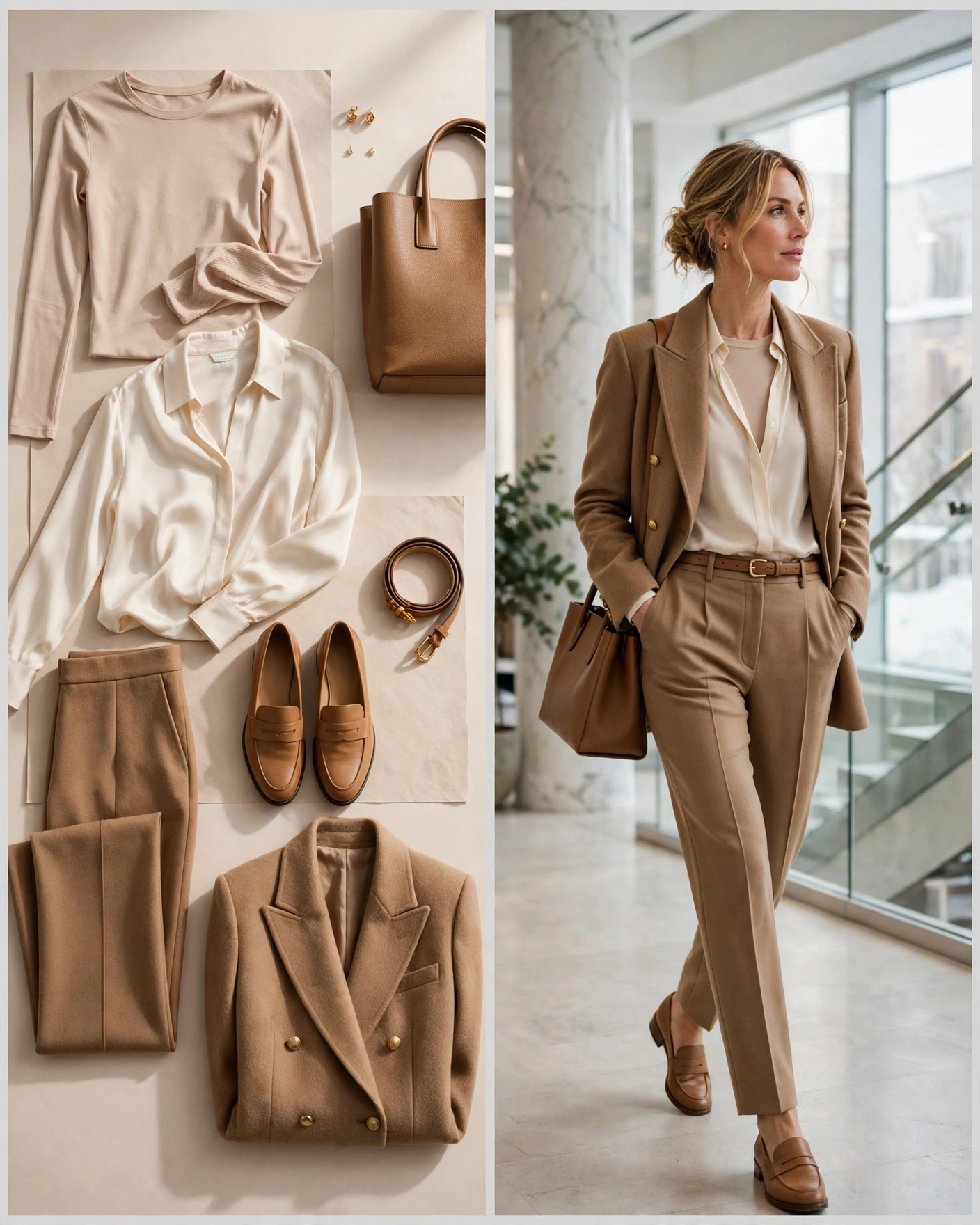
Invisibility starts with the fabric itself. Silk and fine merino wool are the two fibres that insulate in millimetres rather than centimetres: they trap warm air in a layer so thin it follows your body like a second skin, and their smooth surfaces let blouses and trousers glide over them instead of clinging. Cotton thermals are the trap to avoid — they absorb moisture, turn cold against the skin and stay bulky when they dry — and chunky waffle-knit base layers will emboss their texture through any fine fabric above them. Fit matters as much as fibre: choose a body-skimming cut that touches the skin everywhere without compression, because loose thermal fabric folds, and every fold becomes a visible ridge under tailoring. Under a cream silk blouse and camel tailored trousers, a nude silk thermal adds a full layer of warmth while the outfit reads as nothing but polished summer-weight tailoring.
Choose Thermal Tights That Read as Regular Hosiery
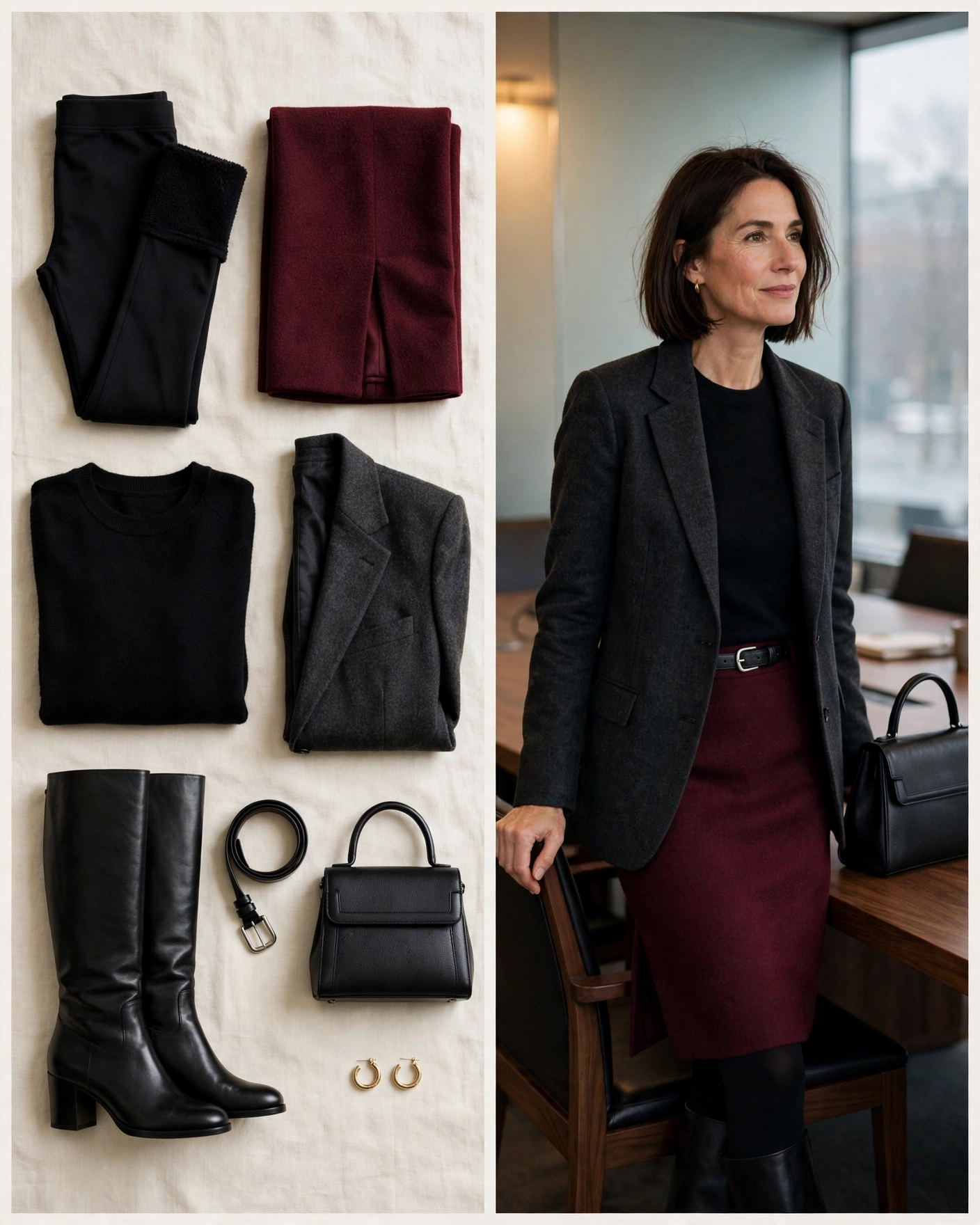
Skirts survive winter when what happens underneath them looks like hosiery and performs like insulation. Fleece-lined tights with a matte finish are the easiest swap in this whole guide: on the leg they read as ordinary opaques, but the brushed inner surface holds warm air against the skin and blocks the wind that cuts straight through standard tights. Look for a wide, flat waistband that sits smoothly under a skirt’s lining, and avoid anything with a sporty sheen, contrast stitching or a logo at the ankle — athletic leggings give themselves away the moment they leave the gym. Footless thermal leggings are the alternative on milder days, worn under trousers or with socks and boots where the ankle never shows. A burgundy wool pencil skirt, black fine-knit sweater and charcoal blazer over matte fleece-lined tights look like standard boardroom polish, with not a hint of the insulation underneath.
Hide the Neckline: Scoops, V-Necks and Open Collars
More thermals are betrayed at the neck than anywhere else. A crew-neck base layer under an open shirt or a low blouse creates a telltale crescent of fabric at the throat, and the whole hidden layer stops being hidden. The rule is simple geometry: your thermal neckline must sit lower and wider than every neckline worn above it. A deep scoop disappears under an open-collar shirt or a blouse left unbuttoned to the second button, a V-neck thermal vanishes under wrap tops and V-neck knits, and a wide boat neck is the risky one — it drifts toward the shoulders and shows at the first shrug. Match the colour to the layer above or to your skin tone so even a millimetre of drift reads as shadow, and check the result in a mirror while turning and raising your arms, not just standing still. Under a navy suit and a crisp white open-collar shirt, a black scoop-neck merino thermal stays completely out of sight all day.

Look for Flat Seams and Bonded Edges That Never Print Through
A thermal can be tissue-thin and still give itself away if it is badly finished, because raised seams press against the fabric above them and draw a map of the layer underneath. The constructions that stay invisible are flatlock seams that lie completely flush, bonded or laser-cut edges at the neck, cuffs and hem, and fully seamless knits that have no side seams at all. Position matters too: seams that run under the arm and down the centre back stay hidden, while a seam crossing the hip bone or the shoulder point will show through a fitted dress by midday. Skip lace trim, scalloped edges and printed logos anywhere they would sit under a smooth outer fabric — all three telegraph straight through silk and fine wool. A charcoal wool sheath dress worn over a seamless charcoal thermal with bonded edges keeps a completely unbroken line from shoulder to hem, at a desk or standing to present.

Tuck In and Smooth Down So Nothing Bunches at the Waist
The waistband is where layered outfits fall apart: two or three hems left loose will migrate, fold and build a visible roll exactly where your trousers or skirt sit closest to the body. The professional fix is to build one single smooth stack — tuck the thermal top into the thermal bottoms or tights first, then let the trousers or skirt waistband close over the whole stack, so from the outside there is only one clean line. Longline thermal tops that reach the hip, and bodysuit-style thermals that fasten below, remove the untucking problem entirely. Whatever you choose, do the sit-down test before you leave: sit, stand, reach for a shelf, then smooth every layer flat again, because layers settle in the first ten minutes and stay where they settle. Under grey plaid wide-leg trousers and a burgundy fine-knit sweater, cream thermal leggings tucked and smoothed in this order keep the waistline as clean as a single-layer outfit.

Size the Outer Layer Up When the Fabric Is Fine
Sometimes the thermal is perfect and the outfit above it is the problem. Unlined dresses, fluid silk blouses and fine-gauge knits have nowhere to hide even a whisper of extra fabric, and a base layer turns them clingy in exactly the wrong places. The answer is to give the outer layer a little honest room: choose relaxed rather than body-conscious cuts on the days you layer, favour lined trousers and structured fabrics that hold their own shape, and do not be afraid to take the next size up in a blazer or dress you plan to wear over a brushed thermal in deep winter. The test is movement, not the mirror — sit at a desk, reach up to a shelf and twist to pick up a bag, and if nothing pulls, outlines or rides, the sizing is right. A relaxed grey wool suit with a cream fine-knit over a black brushed thermal looks deliberately slouchy and elegant, never stuffed.

In Summary
Invisible warmth is a system, not a product: a silk or merino base that moulds to the skin, matte thermal tights that pass for ordinary hosiery, a neckline that stays below every collar above it, flat seams that never print through, layers tucked into one smooth stack, and an outer layer with enough room to move. None of the six moves adds visible bulk — each one removes the evidence of the layer beneath.
Because the hidden layer never dictates the outfit, everything in the classic winter work palette still works on top of it: camel tailoring, a navy suit, a burgundy skirt, a charcoal dress, grey plaid trousers. The thermals stay constant from day to day while the polished layer rotates, which makes cold-morning dressing faster, not slower.
So build your base layer once, properly — the right fibre, the right neckline, the right fit — and let it disappear. Warm on the commute, smooth in the meeting, and not a single ridge, roll or stray crescent of fabric to give the secret away.